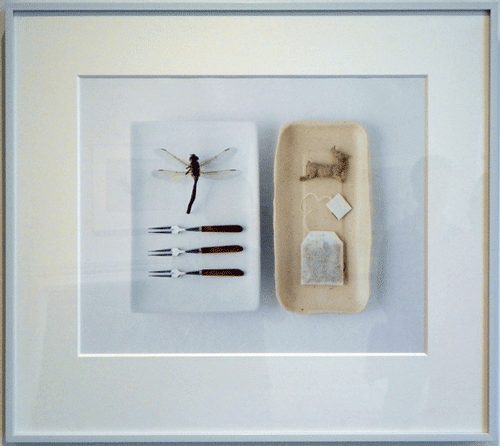
New post on the new, improved DoNArTNeWsPhiladelphia Art News Blog about Kimberly Witham‘s photography exhibit duringPhiladelphia Open Studio Tours 2012 titled The White Series. The photographers work is influenced by natural history dioramas, cabinets of curiosity and still life paintings. Read DoN‘s interview at DoNArTNeWs.
The Photographic Society of Philadelphia, the oldest continuously active photographic society in the United States, marks its 150th anniversary with a major exhibition opening on November 4th, 2012 at The Plastic Club Galleries on the Avenue of the Artists in Center City Philadelphia.
The juried exhibition, which will be open Sundays November 4th, 11th, 18th and 25th from 1:00 5:00pm and Tuesday evening November 20th from 6:00 9:00pm, can be experienced at The Plastic Club, 247 Camac Street, Philadelphia, PA.
Presenters will include many of the outstanding ninety-six members of PSoP some who have shown their work in galleries throughout the US, Europe and Philadelphia. The exhibition will be juried by a panel of three distinguished members of the photographic community Kyle Cassidy, JJ Tiziou and Martin McNamara.
During this celebratory year, The Photographic Society of Philadelphia will draw attention to its longevity (the third oldest in the world founded in 1862) and illustrious history. Documentary, artistic and scientific works by many of its members have featured prominently in the history of American photography. Changes in technology have moved forward dramatically and no longer dictate that photographers must grind their own lenses, or make their own cameras. The digital era and instant have become the norm.
President of PSoP, Eileen Eckstein, noted that The object of the Society, as stated in the constitution, was to increase and diffuse knowledge of the natural laws which relate to the action of light, and particularly to promote improvements in the art of photography. And, she added, rhetoric aside, the philosophy, developed one hundred and fifty years ago, is as fresh today.
Since its inception, The Photographic Society of Philadelphia has been a haven for both amateur and professional photographers who come together for photographic outings, educational lectures and lively discussions on techniques, style and the art of photography.
The Amateur Photographers of this city have long felt the want of opportunity for full and free interchange of views relative to their favorite pursuit. Under the conviction that we might readily form an association whose re-unions would be agreeable and beneficial, I have made bold to take the initiative step, and to ask the favor of your attendance at a preliminary (and unceremonious) meeting at my laboratory, on Tuesday evening, December 4th, at half-past seven oclock.
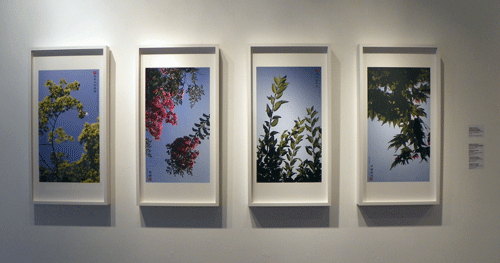
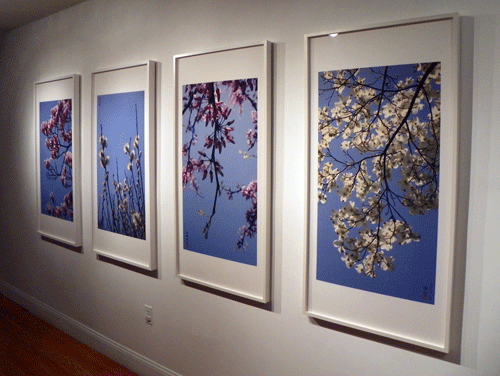
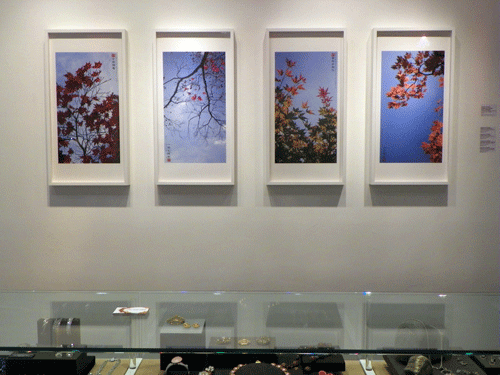
Amie Potsic lived in San Francisco for many years and found when she moved back to Philadelphia that she had missed experiencing the changes of the seasons. As a world traveler, the photographer shoots pictures everyday and found the relationship of taking pictures at home, where she grew up, can feel fresh and new. For three years Amie took pictures everyday going through the seasons and began to see the Asian influences of her travels in the photographs of Philadelphia trees.
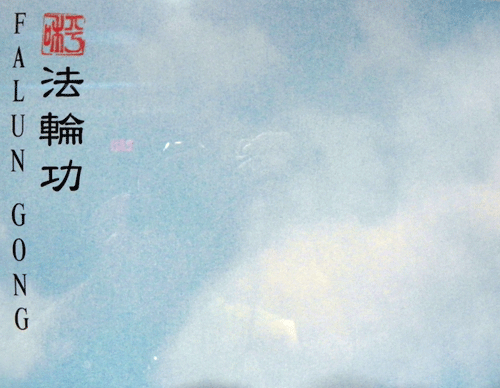
The exhibit, curated by Butch Cordora at Ven and Vaida Art & Jewelry, for the first time gathers images representing all four seasons in one show. The effect is sublime with groupings of images throughout the gallery communicating the beauty of the Philadelphia landscape and how trees can express an underlying narrative. One day the artist saw a protest in Rittenhouse Square that was against the Chinese government torturing people for practicing a religion called Falun Gong and brought the ideas and the esthetics together in a subtle combination of traditional beauty and clever protest.
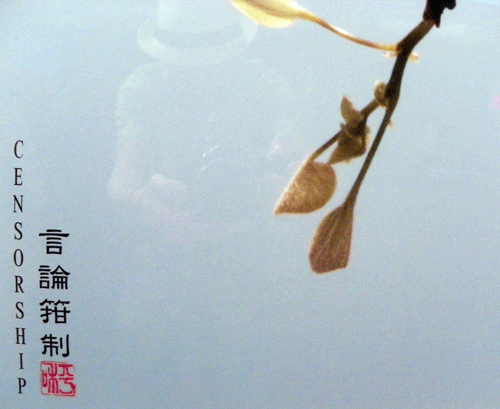
The collection of images has grown over time Amie Potsic says, “It’s interesting, this is the closure of the project where I now have the four images per season and each season deals with a particular issues.” Important social issues like reproductive rights, religious freedom, censorship and working conditions that we can discuss openly in America but are suppressed by the Chinese leadership. “I think it’s interesting, in the 1980s and 1990s there was a lot of political work, all the post-modernist work was really political and then that sort of fell out and it became that work was not about anything topical per se and I think that shift is coming back. A – there’s a lot of topics worth talking about and B – people are wanting more from their artwork and more of that critical discussion. Having something to say again.”
The Made in China images are beautiful and expertly crafted but they each have a little zinger added with Chinese text paired with the translation in English. First impressions look like a traditional Asian signature but when you look closer the words are political in nature offering a subliminal message about government trying to control the way people think and behave.
“I think there’s an expectation now that artwork be easy to understand. People feel that they think they should ‘get it’. That it should be understandable but that’s not always the function of artwork. There’s a lot of levels of ways you can interact with art on just a visual level, a purely conceptual level and every continuum in between. I think it’s a real stumbling block for people who require that they need to understand everything they’re looking at and not just have an experience. I used to have a class where I taught at the San Francisco Art Institute, I would take them to the San Francisco MOMA, there’s an Yves Klein painting that’s a blue color field painting, a cobalt blue painting, and I knew that when we would meet back at the cafe that there would be this one student who would say, ‘Why is that art? I can do that.’ It was like clockwork every time, but it was the perfect conversation to have because the idea was, ‘But, you didn’t. He thought to do that, he’s making you question what is art.’ And if it pisses you off, all the better.”
“Girls are getting into abstract analysis That want to make that intuitive leap They are making plans that have far reaching effects” – Talking Heads, The Girls Want To Be With The Girls, More Songs About Buildings & Food
Gallery 339at the corner of 21st and Pine Streets is dedicated to fine art photography, the chic space always has something special and inspirational to see. Spending time alone there with the incredible images is one of DoN‘s favorite things to do because there is nowhere else like it to see art by master photographers (except PPAC, of course) but that’s across town. The gallery has become a destination for photography lovers from around the world and it’s right down the street from Haus ofDoN. Usually the gallery is dedicated to just a few photographers, focussing on a body of work but More Photos About Buildings and Food is a large group theme show with many of the great photographers who have exhibited in the past at the gallery.
The opening night was more like a party than an opening with a DJ spinning classic Talking Heads songs at ear throbbing volume making it impossible to talk but that only meant the party spilled out into the street. The eclectic mix of images are either about buildings or food, all of them spectacular and special examples of the state of the art in fine art photography. Some are easy to look at, some disturbing and deep, others are pop art or documentary style. The mix is heady and exciting, the crowd was loud and rambunctious – just the way DoN likes it.
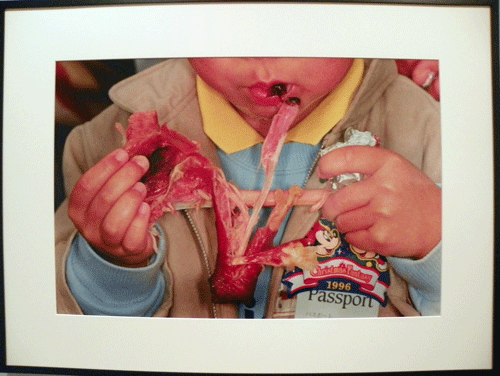
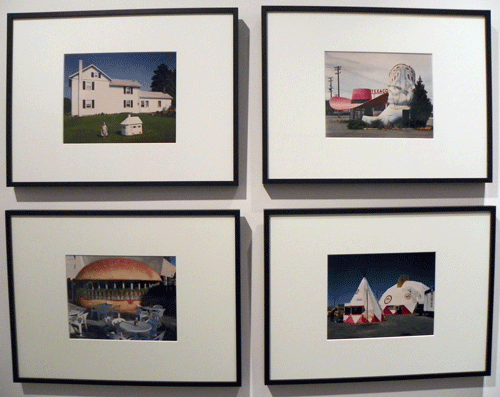
More Photos About Buildings and Food at Gallery 339, Martin Parr, Turkey Leg, Disneyland, Tokyo, 1998, chromogenic print
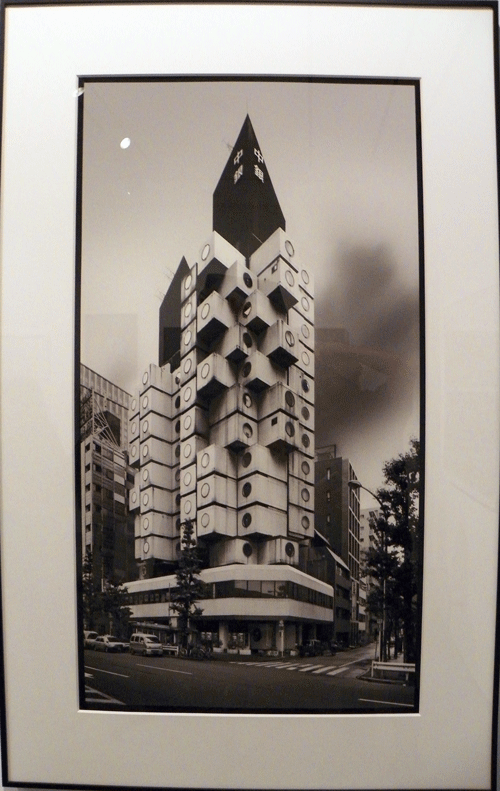
More Photos About Buildings and Food at Gallery 339, Vincent Feldman, Shizuoka Shinbun and Broadcasting System Tower, carbon pigment print
Vincent Feldmanlives down the block from DoN and it was a nice surprise to see him and his family at the show, it was an even better surprise to see his work in the show with spectacular prints of Japanese modern architecture. Over the roar of the music we chatted about his contribution to the exhibit. DoN asked how Vincent Feldman, a professor of photography atUniversity of the Arts, got involved with More Photos About Buildings and Food at Gallery 339?
“Well, I live in the neighborhood near the gallery, so I know Martin McNamara, the owner and director of the gallery and he’s actually purchased some of my work in the past. So the work that he owns is what’s being exhibited but they’re a larger scale. I take pictures of buildings and that’s part of the theme of the show, so, it worked out for this exhibit.”
DoN asked how long Vincent Feldmanhas been involved in photography? “Thirty-plus years, most of my life.” Not long ago the artist unloaded a bunch of enlargers for people to glean from the street which lead DoN to think maybe he had gone digital. “I still have some enlargers, but the prints I’ve been doing lately, I would say, are mostly digital but I always shoot film. It’s four by five negatives, there’s nothing comparable for me to shoot digitally in that size. I use a large format 4 x 5, Toyo, a Japanese company”
Do you still have a darkroom, they seem to be going away? “Yes. There are still a lot of darkrooms, in fact, they seem to be a growth industry since a lot of them have been decommissioned and I teach, too, and a lot of students want to print in the darkroom. They want to make real prints. It’s a magical process, I love working with the computer but I think you should know what real photography looks like before you try and make it with a computer. You can make anything, you can print out an M16 now, a working gun, so what’s to prevent students from doing that, when you give them a computer you’ve got to focus them and the computer’s not a great thing to focus with if you’re just learning.”
“I have a book coming out in the Spring called Philadelphia City Abandoned about the civic architecture of the city. I’m working with Paul Dry a Philadelphia publisher and he’s been really great and hopefully it’s going to be a beautiful book that will last a long time.”
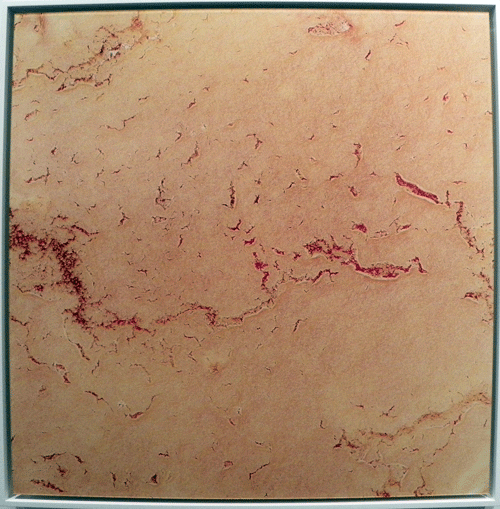
More Photos About Buildings and Food at Gallery 339, Mary Parisi, Wounded Soup, chromogenic print
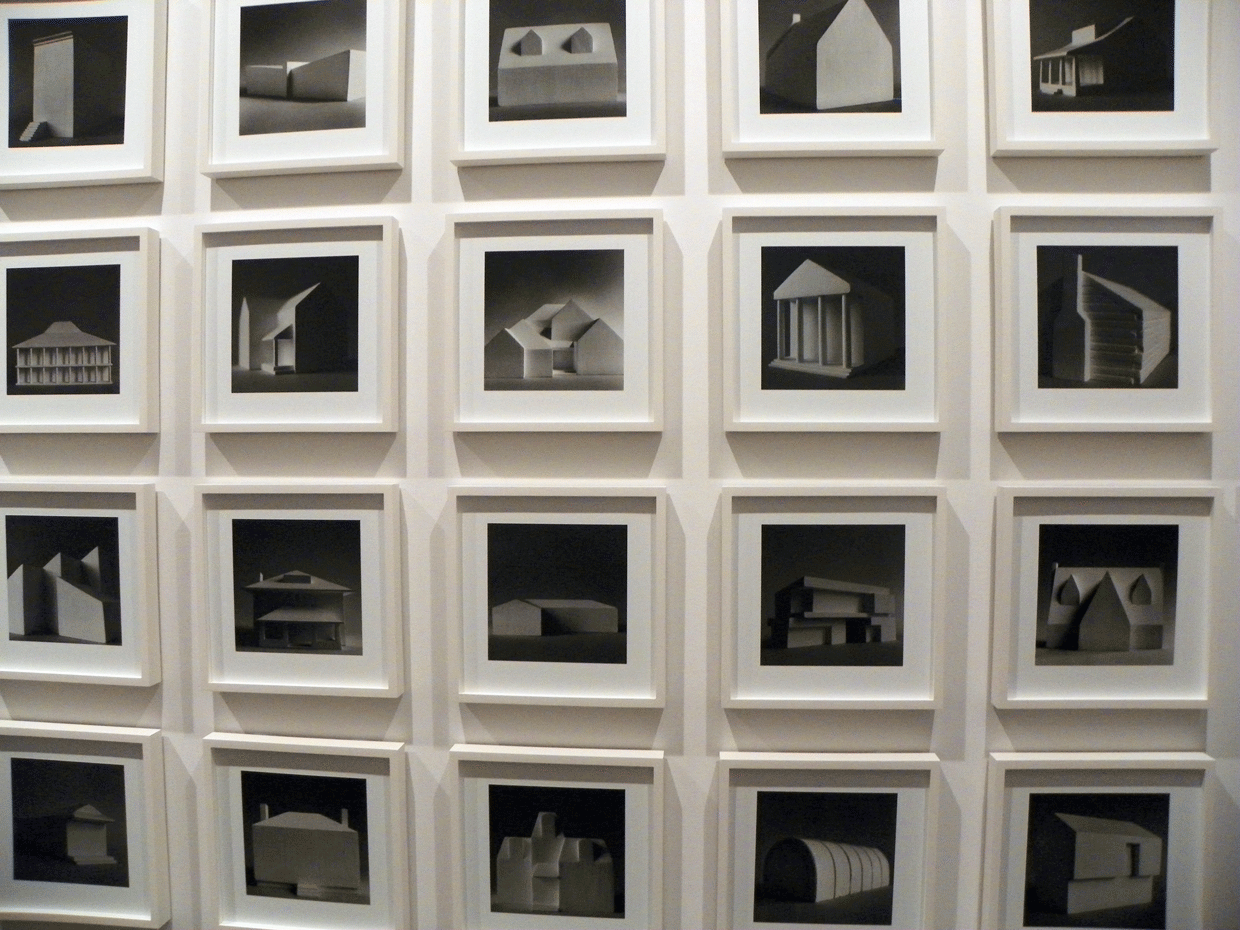
More Photos About Buildings and Food at Gallery 339, Ion Zupco, American Homes Portfolio, gelatin silver prints