Category Archives: Photography Philadelphia

Philadelphia photographers and photographs.

Ivette Spradlin, Everything Changed, Then Changed Again at Center for Emerging Visual Artists

Ivette Spradlin, Everything Changes, Then Changed Again at Center for Emerging Visual Artists

Ivette SpradlinShuanna with Child, Braddock PA, inkjet print, Everything Changes, Then Changed Again at Center for Emerging Visual Artists

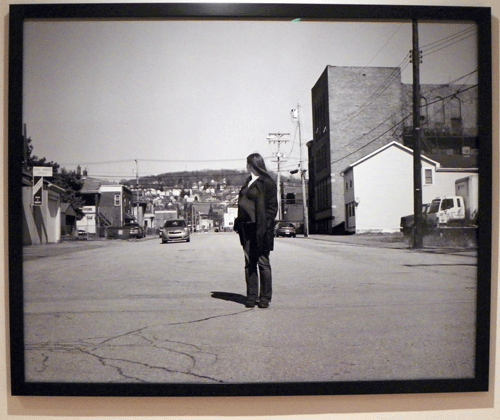
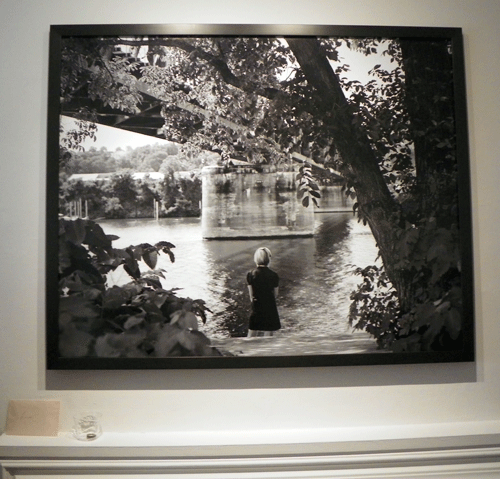
The Center for Emerging Visual Artists has had artist exchange exhibits with the Pittsburgh Center for the Arts for the past five years.  The current show which ends April 20th is Ivette Spradlin‘s Everything Changes, Then Changed Again, is an exhibit of large scape black and white “portraits”.  Ivette Spradlin has ties to Philadelphia because she went to grad school and taught here at Tyler School of Art, graduating in 2007 after which she briefly moved back to Atlanta then on to Pittsburgh. When she began working there Ivette realized she needed to build a community of friends and figure out a way to meet people. Her photography project came about from the need and desire to connect to people and wasn’t originally intended to be shown but more of a way to get access to people.  The collection was first shown at Pittsburgh FilmmakersCFEVA is the second venue for the collection. 

I wanted to start shooting portraits again so I started asking a couple of people that I knew there and it kind of built up from there.   I would meet people and ask if I could take their portrait and I would have them choose a space and location and let them know that I was looking for a space in transition.   Some of these people are in some sort of transition in their own life and I felt I was, so, this was a way of documenting that transition for me and for them.  And getting to know Pittsburgh.”Ivette Spradlin at Center for Emerging Visual Artists
Ivette Spradlin at Center for Emerging Visual Artists 

The Center for Emerging Visual Artists has had artist exchange exhibits with the Pittsburgh Center for the Arts for the past five years.  The current show which ends April 20th is Ivette Spradlin‘s Everything Changes, Then Changed Again, is an exhibit of large scape black and white “portraits”.  Ivette Spradlin has ties to Philadelphia because she went to grad school and taught here at Tyler School of Art, graduating in 2007 after which she briefly moved back to Atlanta then on to Pittsburgh. When she began working there Ivette realized she needed to build a community of friends and figure out a way to meet people. Her photography project came about from the need and desire to connect to people and wasn’t originally intended to be shown but more of a way to get access to people.  The collection was first shown at Pittsburgh FilmmakersCFEVA is the second venue for the collection.
Ivette Spradlin at Center for Emerging Visual Artists

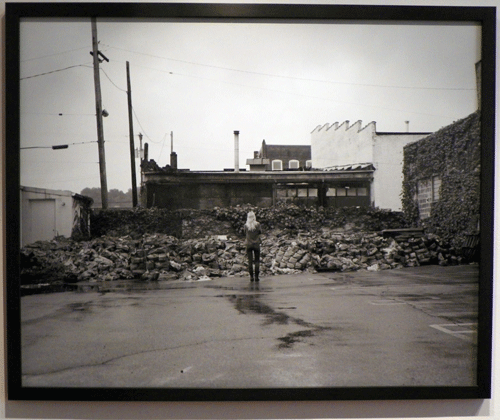
Ivette Spradlin, Heather in Marchester, Pittsburgh PA, inkjet print, 42″ x 52″

I think that those ideas about adapting are always in my head  and that’s definitely what this work was for me, adapting to Pittsburgh and learning to be a person there, an artist there, a teacher there, a friend.   When I first started it, I really wanted the figure to be really small and encompassed in a landscape, part of that is a visual thing but Pittsburgh’s landscape it can kind of tower over you, there are a lot of mountains, and I wanted it to feel like you’re enveloped in the landscape, almost a little bit lost in it.   Then some of the turns (of the subject) we came up with are kind of an optimism, a hope, like the turn of a transition, like their life was looking towards something else.  Some of them are getting divorced, some of them are having babies, so I think that had a lot to do with that.”  Most of Ivette Spradlin’s portraits were collaborations with her subjects as far as setting and wardrobe but sometimes she would be led to a certain spot and learn some of the subject’s personal history.   “We shot in many locations for each person and that’s the part where the photographer makes the decisions, like where you’re going to photograph them?  And where they’d look good, what’s nice aesthetically.”

Written and photographed by DoN Brewer 

[disclosure page] All ad links in this blog post go to Amazon.com  

Recommended reading from Ivette Spradlin
Veronika Schmude at Apple Jacks Studio

Veronika Schmude at Apple Jacks Studio

Veronika Schmude at Apple Jacks Studio

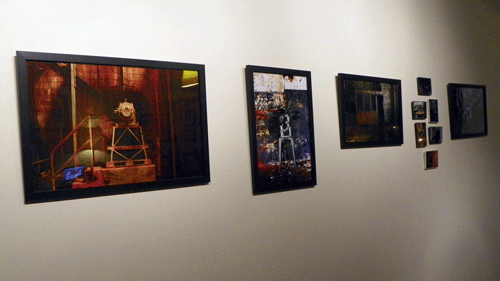
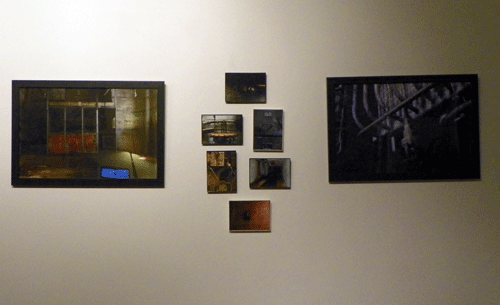
“I went running out on the eye beam because I saw this shot.  And my friends were like, ‘They were right about you!'”  Veronika Schmude is an urban explorer who loves to takes risks to get a great photo.  Veronika asked DoN to help her hang her show at Apple Jacks Studio at 319 North 11th St, 4th Floor, Philadelphia, the arts building near Vine Street, it’s flattering to be asked for artistic advise, especially in a hot art spot like the Khmer Building with Vox Populi and Tiger Strikes Asteroid.  We decided to arrange the work formally with an even eyesight line with some quirky informal arrangement of the smaller pieces mixed in.  With the broad spectrum lighting Veronika installed and the industrial loft vibe of the gallery, the photographs looked perfectly amazing.

Veronika Schmude at Apple Jacks Studio

Veronika Schmude at Apple Jacks Studio

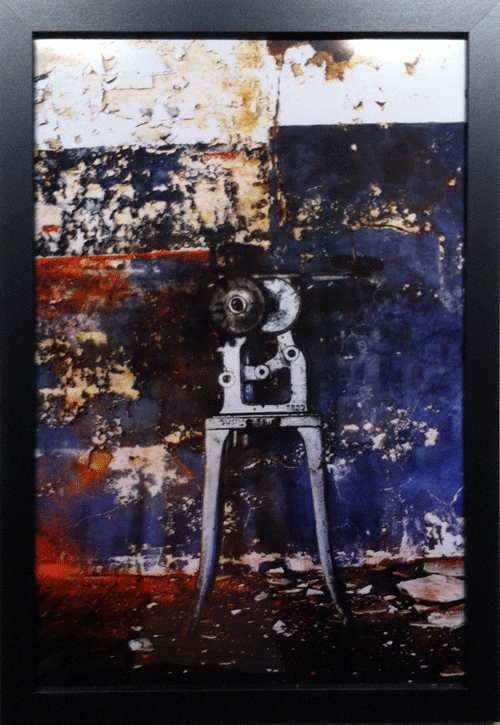
Veronika Schmude explained to DoN, “All of these are the Richmond Power Plant except for the center piece, the center one is called Machine and was taken at Global Dye.  Which they’re apparently shooting a movie in; the Richmond Power Plant had a bunch of movies shot there: 12 Monkeys (Special Edition), is the most known, Transformers: Revenge of the Fallen (Two-Disc Special Edition), that was shot there as well, parts of it and it’s actually a fascinating building.” DoN wondered how one get’s inside a locale like an abandoned power plant?  “They make attempts to keep us out by putting grating and a fence but..” A conversation starts between Veronika and a couple of her explorer pals about which tools the authorities would be consider those used for breaking and entering and those for hobbyists, Dremel Rotary Toolare for hobbyists (wink, wink!)

Acting normal and like you belong there is a technique the explorers use if confronted with questions as to why they’re there.  “I’ve always been fascinated with abandoned buildings and industrial sites since I was a kid.  I would go into abandoned buildings in the town I grew up in, Springdale PA, about forty miles outside of Pittsburgh.  And between the abandoned warehouses along the train tracks and the abandoned homes I came across interesting stories and one story in particular.

Veronika Schmude at Apple Jacks Studio

Veronika Schmude at Apple Jacks Studio

“There was this one house that was cut into three different apartments.  Well, this one apartment I went into, they were all open, because it was a small town and they didn’t need to lock up anything really.  Everything was left as is, they literally picked up and left, down to food on the stove in the pot and I ended up later meeting the woman who used to live there.  She was obese to the point of bed-ridden, her husband had elephantiasis, and they used to have two kids living in this apartment.  And, according to them, these children became possessed and they literally had to pick up and leave and the children were eventually taken away because they were, well, they had some problems.”

DoN asked Veronika about the emotional sensations she experiences exploring abandoned spaces since she started as a kid?  “Yeah, I have to say there is something almost appealing, very sexy about the whole smell of, like, decay and rust and the air’s so thick you can feel the particles, there’s dust landing on you. There’s something like also very innocent about it because it takes me back to my childhood, but, it’s a thrill, too.  I mean, it’s definitely a rush getting into these places without getting busted.  Getting back out with everything intact.  Some buildings I have to be quicker than others, get in and get out, depending on if there’s homeless or whatnot, squatters.  I shoot with a Canon 450D, on my last shoot which at the Saint Nickolas Coal breakers I borrowed a friends camera, both Canon, and an Canon XTi, the Canon XTi has a 135 mm wide angle and my camera, the 450D, had a 90 mm normal lens which I use for closer, smaller shots.  I use a color enhancing filter and I adjust my white balance to give a warm tone or a cool tone…which gives that warm red hue, makes the rust colors really pop.”

Veronika Schmude at Apple Jacks Studio, 319 North 11th Street, Floor 4, Philadelphia PA 19107

Written and photographed by DoN Brewer

[disclosure page] All ad links in this blog post go to Amazon.com

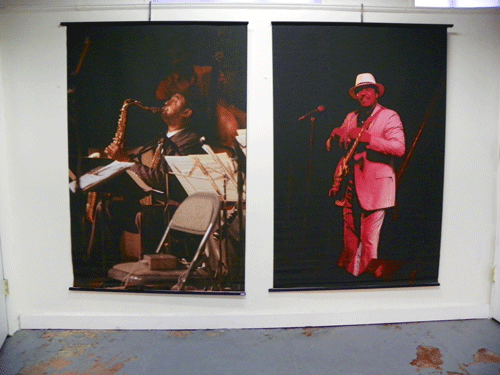
Robert J. Brand, Jazz Photographs, Downstairs Gallery at the Plastic Club

Robert J. Brand, Jazz Photographs, Downstairs Gallery at the Plastic Club

Robert J. Brand, Jazz Photographs, Downstairs Gallery at the Plastic Club

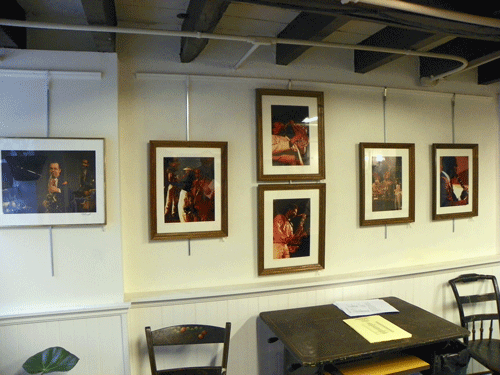
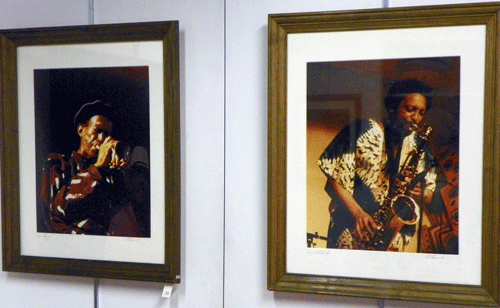
The Downstairs Gallery at the Plastic Club usually hosts a group art show, April, Jazz Month, is exhibiting a collection of photographs by Robert J. BrandDoN asked Bob about the photographs in the one-person show?  “The show is photos of jazz musicians in performance and I’m not selling anything.  I’m giving away work to friends and my friends all support Obama for President.  So, they write a check to Obama for President, then I give them a piece of art.”

Robert J. Brand, Jazz Photographs, Downstairs Gallery at the Plastic Club

Robert J. BrandJazz PhotographsDownstairs Gallery at the Plastic Club

DoN noticed that the prices are, shall we say?  Affordable.  “Well, we’re not going to win this election with the Koch Brothers.  It’s going to require people giving money, making phone calls, ringing doorbells, walking streets and turning out the vote.  So, making the art affordable is part of getting people involved. Sometime during April, I have a portfolio of twenty-two pictures that I took in Mississippi in 1966.  The portfolio is titled It’s Always Been About Voting. And it’s a limited edition, forty boxed sets and all the money from that will go to groups that are fighting for the right to vote.  The money’s going against all the anti-voting actions of state governments around the country.”

Robert J. Brand, Jazz Photographs, Downstairs Gallery at the Plastic Club

Robert J. BrandJazz PhotographsDownstairs Gallery at the Plastic Club

DoN asked Robert J. Brand when he began taking pictures?  “I got my first camera in 1963, around Thanksgiving when I had just started college.”  Are you shooting digitally now?  “I have gone digital but some of the pictures in this show are silver bromide images but everything I do now is digital and we’re digitizing as fast as we can. The 1966 pieces have all been  digitized. In 1965 and 66, I was in Mississippi several times, the pictures in the portfolio all came from the James Meredith march.  He set out to march against fear to show people they could register to vote and he was shot the first day of the march.”

“And ten thousand people came from around the United States to finish the march.  And, we did.  Before that we worked on what became the first integrated Head Start Program in Mississippi which we physically built over Christmas and New Years of ’65, ’66…I guess I was twenty years old, there were over ten thousand people there.”

Plastic Club Art Studio and Gallery, 247 South Camac Street, Philadelphia PA, 19107  215-545-9324

Written and photographed by DoN Brewer

Read more about Jazz Show at The Plastic Club at Side Arts Philadelphia Art Blog

Jazz Show at the Plastic Club

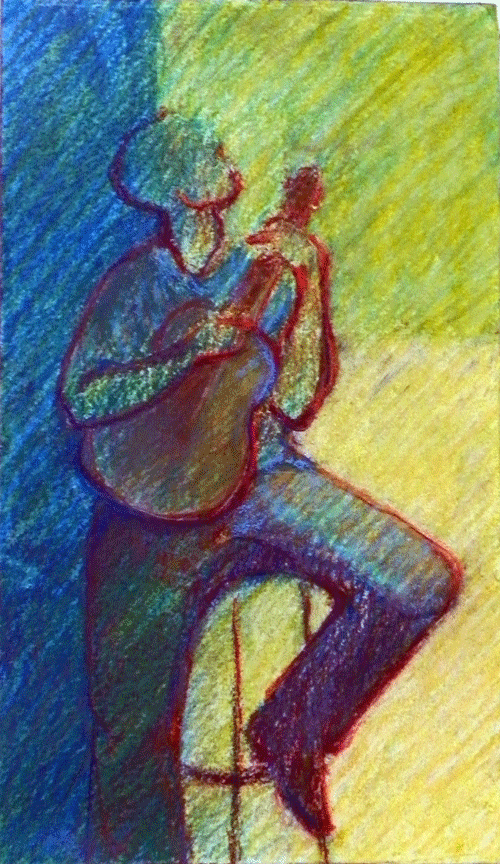
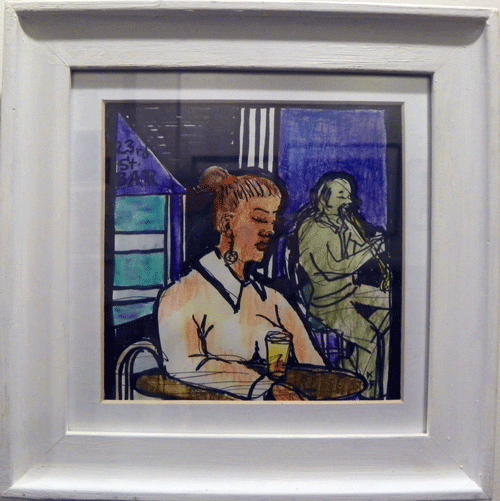
Cynthia Harvey, Player, pastel, Jazz Show at the Plastic Club

Cynthia Harvey, Player, pastel, Jazz Show at the Plastic Club

Alan Klawans, the Exhibitions Chair for the Plastic Club is stepping aside and Susan Stromquist is taking charge of the venerable art club’s exhibition calendar.  The art direction by Alan has been impeccable and the current art exhibition, Jazz Show, is a smash hit.

The theme challenged the artist membership to create new work related to Jazz.  The resulting collection of eighty artworks is a medley of soulful paintings, bebop abstracts, hip photographs of musicians lined up like a horn section and wild riffs on convoluted mixed media constructions.  At the awards President Bob Jackson noted how some artists couldn’t pull from their regular repertoire and make something old fit the theme.  Good thing. Because jazz needs extra space to be new, experiment and different each time it’s played, it’s never the same old thing.  The Jazz Show is smooth, moody and deep, the art spaced out so each piece gets it’s solo performance.

Michael Mastrogiovanni, Jennifer Tsui, Jazz Show at the Plastic Club

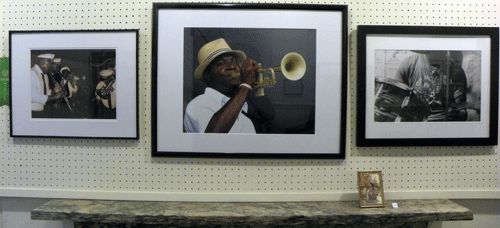
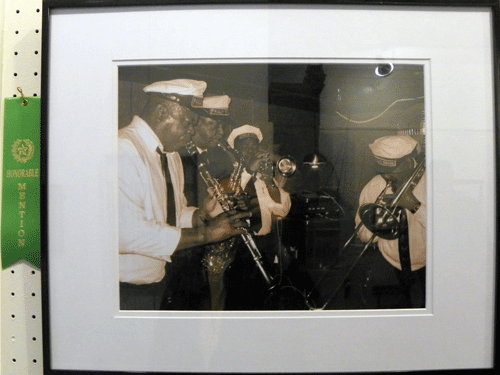
Michael Mastrogiovanni, New Orleans, photograph, Michael Mastrogiovanni, Jazz Fest, photograph, Jennifer Tsui, Leaving the Village Gate, 1976, collage (on mantle) and Joseph DeFay, Jazz on South Street, photograph at the Jazz Show at the Plastic Club.

Michael Mastrogiovanni, New Orleans, photograph, Jazz Show at the Plastic Club

Michael Mastrogiovanni, New Orleans, photograph, Jazz Show at the Plastic Club

Karen L. Freeman, Kind of Blue, mixed media, Jazz Show at the Plastic Club

Karen L. Freeman, Kind of Blue, mixed media, Jazz Show at the Plastic Club

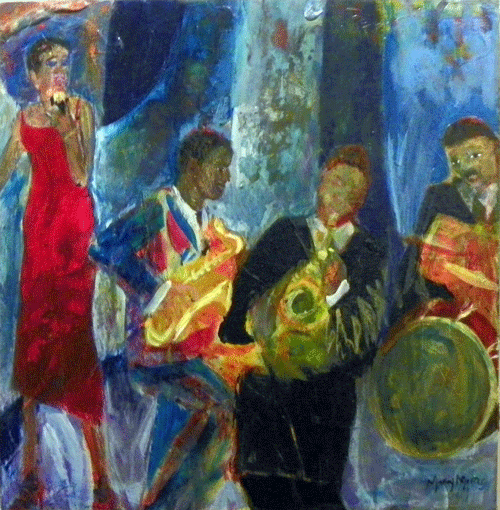
Marcy Morris, Mo’s Band, acrylic, Jazz Show at the Plastic Club

Marcy Morris, Mo’s Band, acrylic, Jazz Show at the Plastic Club

April 1, 2012, the reception was packed like an underground club, the beat of drums and sizzling keyboards resonated from the Judy Shenkman Studio upstairs all the way to the Downstairs Gallery.  After the awards ceremony, the packed house opened up the floor and couples danced to the music, others tapped their toes and sipped wine.  The vibe of th Plastic Club was like a secret speakeasy and no one wanted to leave at closing.

The Plastic Club, 247 South Camac Street, Philadelphia PA – through April 27th.

Written and photographed by DoN Brewer

Read more at Side Arts Philadelphia Art Blog

Bob Bruhin at Cafe Twelve – Images from Eraserhood

Bob Bruhin at Cafe Twelve - Images from Eraserhood

Bob Bruhin at Cafe TwelveImages from Eraserhood

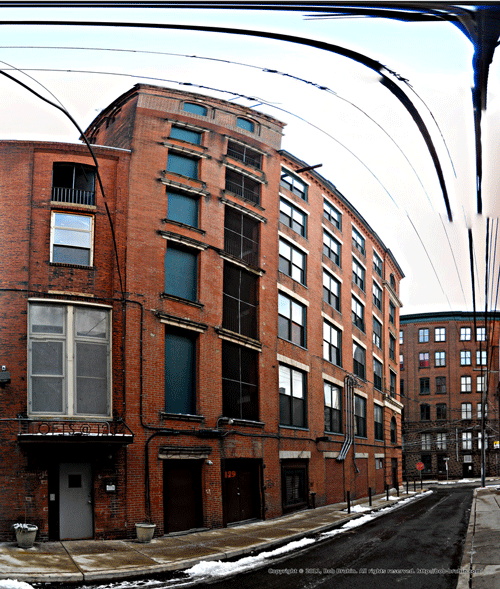
The Photographic Society of Philadelphia‘s current solo show is photographer and blogger Bob Bruhin, at the reception in the comfy Cafe Twelve, 212 S. 12th Street,  Bob explained to a group of society members his collection of photographs.  “This is a small selection that I call Images from the Eraserhood, it’s photos that were taken originally for my blog eraserhood.com, which is discussing the neighborhood North of Vine Street, South of Spring Garden Street, East of Broad Street and West of 7th or 8th depending on how you determine it.  It’s an historically industrial neighborhood that used to have the Reading Railroad running through it, there a big old thing called the Reading Viaduct which was where the railroad ran before they built commuter tunnels.  It’s filled with old industrial properties, beautiful stunning buildings.  In the mid to late 60’s the artist David Lynch lived there, he was a student at the Pennsylvania Academy and the geography and the look and the tone of that neighborhood of that time inspired his first feature film entitled Eraserhead (Import, All Regions).  So recently as the neighborhood has developed it’s taken on the name Eraserhood, it kind of stuck to the neighborhood,”
Bob Bruhin at Cafe Twelve - Images from Eraserhood

Bob Bruhin at Cafe TwelveImages from Eraserhood

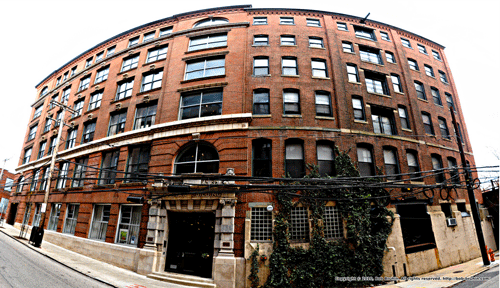
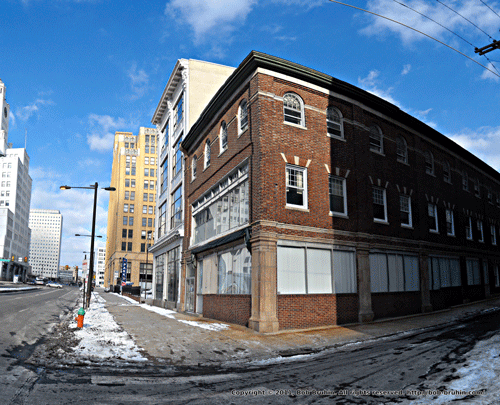
“All that fascinated me when I came to work there, I work in a building called the Wolf Building which is an emblem of the factories and condos and offices and apartments, all manner of things.  Rick Wright has his studio in that building.  At the time I was originally photographing only using a cell phone, so what I was doing was taking composite images panoramically, specifically to build up a large enough image to make it worth the trouble.  Eventually I found it amusing enough that I started to use a real small Nikon point and shoot, a simple Nikon Coolpix L20 10MP Digital Camera. But since I became addicted to the panoramic process at that point, I continued to do that and started building larger images, I worked with exposure stacking and high dynamic range to intensify the color and textures of the images.”
Bob Bruhin at Cafe Twelve - Images from Eraserhood

Bob Bruhin at Cafe TwelveImages from Eraserhood

“So it’s kind of an historical study but it’s supposed to be a bit of a twisted historical study just because of the twisted history of the neighborhood, the tone of David Lynch‘s work kind of inspired that. I was further inspired by the fact that it is now a National Historic Landmark called the Callowhill Historic District which has all of these buildings in this show are from the Callowhill Historic District set…these have all been done with the panoramic process and have been enhanced with exposure stacking and high dynamic range.  I bracket all my exposures and combine them digitally at the end wih a more even exposure and also to capture all the texture that I can possibly capture.”

All photographs courtesy of the artist, Bob Bruhin:
http://bob-bruhin.com/
http://eraserhood.com/
http://LandMarrx.com/
Read other reviews of PSoP photographer Karen Schlechter on DoNArTNeWs Philadelphia Art News Blog and Jeff Stroud on Side Arts Philadelphia Art Blog

Movies by David Lynch

Lost Highway

Wild at Heart [Blu-ray]

Mulholland Dr.

[disclosure page] All ad links in this blog post go to Amazon.com